- Ⅰ. Why Is GSM a Core Metric When Sourcing Non-Woven Bags?
- Ⅱ. Mainstream GSM Specs for Non-Woven Bags and Their Common Uses
- Ⅲ. Beyond GSM—What Else Should You Look at When Sourcing?
- Ⅳ. Common GSM Misconceptions in Procurement
- Ⅴ. Scenario-Based Selection: Balancing Budget, Load, Size, and Reuse Needs
- Ⅵ. FAQ
- Ⅶ. Summary
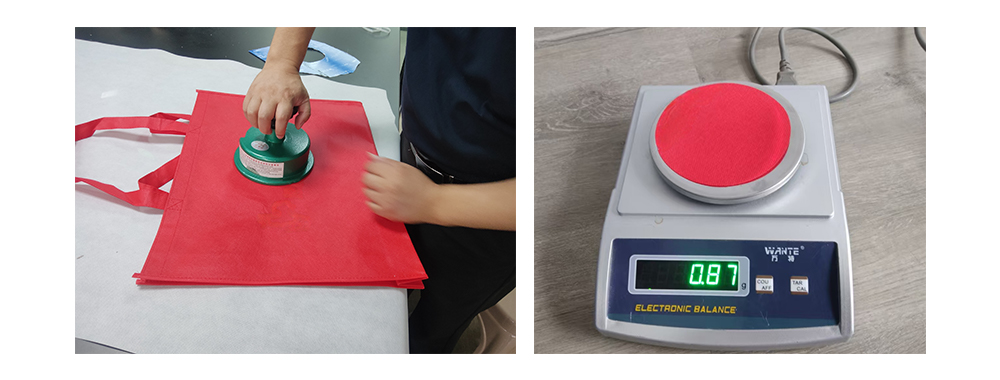
GSM stands for Grams per Square Meter. It is a quantitative standard based on fabric weight and a universal unit of measurement used throughout the textile industry. In simple terms, it tells you how much one square meter of non-woven fabric weighs, measured in grams.
When the raw material and manufacturing process are kept the same, a higher GSM generally means a thicker, denser non-woven fabric with better stiffness and greater load-bearing capacity. Conversely, a lower GSM produces a lighter, softer fabric that offers less load capacity and abrasion resistance.
But here’s the important point: GSM is not the only criterion for assessing quality. Two non-woven fabrics with the same weight can still differ noticeably in hand feel, toughness, print quality, and durability because of differences in raw materials, manufacturing processes, and fiber density.
Ⅰ. Why Is GSM a Core Metric When Sourcing Non-Woven Bags?
Compared with vague descriptions like “lightweight” or “heavyweight,” GSM is a standardized, quantifiable quality parameter and a common reference point for factory production, export quotations, and customer product selection. Its importance comes down to four key aspects:
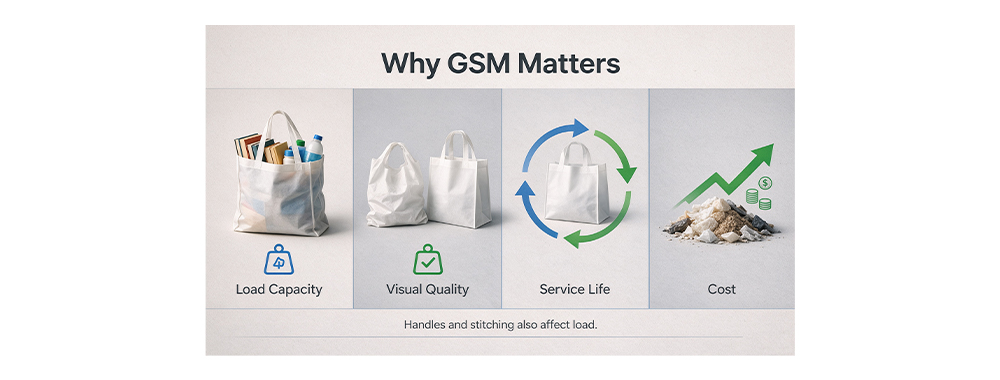
1. It Affects the Bag’s Load-Bearing Capacity
Low-GSM non-woven fabric has a relatively loose structure with lower tensile strength in both the machine and cross directions, making it prone to deformation and tearing when carrying heavy items.
High-GSM fabric is made of denser, tougher fibers with better structural support, so it is better suited to carrying heavier loads such as books, gifts, and everyday goods.
That said, load capacity is not determined by GSM alone. Handle construction, stitch strength, bottom structure, and bag size all influence how much weight a bag can actually carry. When sourcing, don’t look only at fabric weight—evaluate the overall workmanship as well.
2. It Affects Visual Quality and Perceived Grade
Low-GSM non-woven bags feel soft, tend to sag, and show creases easily, which gives them a noticeably budget look. They are better suited to single-use, temporary applications.
High-GSM bags hold their shape better, look neater and more structured, and offer a smoother surface that helps printed designs come out crisp and dimensional—ideal for brand promotion and premium gift packaging.
3. It Affects the Bag’s Lifespan
Higher-GSM non-woven fabric generally offers better abrasion resistance and tear resistance, so the bags can be reused many times over—a better match for today’s eco-conscious, circular-consumption trend.
Lower-GSM bags are made from more fragile material that tends to wear out quickly with repeated use, so they offer a lower reuse rate.
4. It Directly Affects Procurement Cost and Pricing
The higher the GSM, the more raw material is needed to produce the fabric, which usually translates into higher production costs and a higher bulk purchase price.
Matching the right fabric weight to the actual use case is the key to controlling your procurement budget and avoiding wasted resources.
Ⅱ. Mainstream GSM Specs for Non-Woven Bags and Their Common Uses
Non-woven bags on the market typically fall into a few well-established weight ranges, and each GSM level serves a different purpose. Understanding these ranges is some of the most practical knowledge you can have when sourcing.
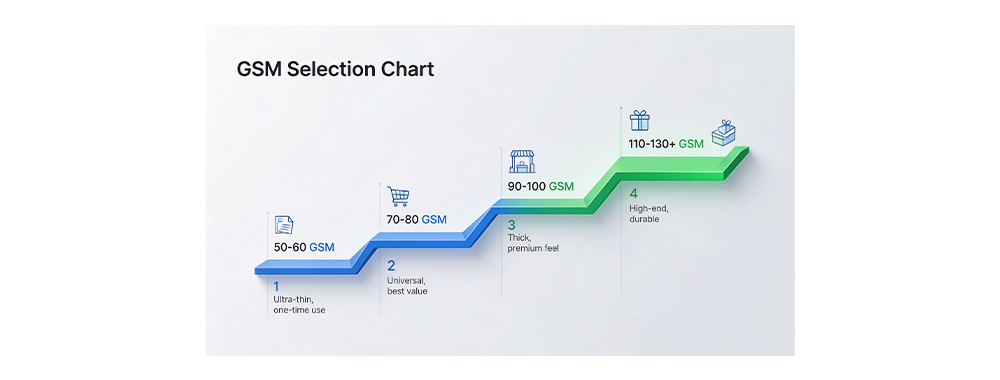
| GSM Range | Positioning | Characteristics | Common Uses |
| 50–60 GSM | Lightweight | Thin and soft with weak structural support; easily deformed or damaged | Short-term street promotions, free giveaways at small events, temporary light-duty carrying |
| 70–80 GSM | All-purpose standard | Balanced thickness and strength at a great price; holds its shape well | Supermarket shopping bags, in-store promo bags, standard advertising bags, everyday light-duty carrying |
| 90–100 GSM | Heavy-duty quality | Dense and stiff, resists sagging; better print quality | Trade show giveaways, long-term in-store use, mid-range gift packaging, corporate business distribution |
| 110–130 GSM+ | Premium | Thick, full-bodied, and structured; superior abrasion resistance and load capacity | Premium brand gift boxes, luxury packaging, high-end corporate gifts, custom reusable bags for long-term use |
Please note that the ranges above are industry reference points. Actual hand feel and load capacity can vary across factories, processes, bag styles, and sizes, so we recommend confirming with samples before placing a bulk order.
Ⅲ. Beyond GSM—What Else Should You Look at When Sourcing?
Many brands run into sourcing traps when ordering non-woven bags through OEM/ODM simply because they focus only on GSM. In reality, bag quality also depends on the following factors:
1. Raw Materials
Bags made from virgin materials generally outperform those made from recycled scraps in toughness, surface smoothness, environmental friendliness, and service life. Two 80 GSM bags—one from virgin material and one from recycled material—can differ significantly in hand feel and tensile strength.
2. Non-Woven Manufacturing Process
Most non-woven bags are made from PP spunbond fabric produced with a thermal bonding (calendering) process. Other non-woven technologies exist, such as spunlace (hydroentangling) and needle punching, but these are rarely used for shopping bags—they are more common in hygiene products, filtration, and padding applications. The process used affects the fabric’s hand feel, density, tensile strength, and printability.
3. Fiber Density and Uniformity
Some fabrics look thick but have loose fibers, a lower actual weight, and poor toughness. Others may not look especially thick, yet their dense, compact fibers deliver far better strength.
4. Handle and Sewing Construction
Handles are the critical load-bearing part of a bag. Stitched handles, ultrasonically welded handles, die-cut handles, and hook-and-loop handles all perform differently under load. The stitching at the bag opening, bottom, and side seams also affects overall durability.
5. Printing Method
Screen printing, heat transfer printing, lamination, and full-color printing each affect print sharpness, color accuracy, and cost in different ways. Print quality is not determined by GSM alone.
6. Size and Bag Style
The larger the bag, the greater the stress it endures when loaded, so larger bags usually need a higher GSM or reinforced handles and bottom construction.
7. Certifications and Environmental Requirements
Depending on your target market, you may also need to consider relevant environmental certifications and compliance standards.
For example, exporting to the EU generally requires compliance with the REACH regulation to ensure the material is free from restricted hazardous substances. In addition, with the EU’s Packaging and Packaging Waste Regulation (PPWR) gaining momentum, verifying whether the non-woven raw material is biodegradable and whether production meets the ISO 14001 environmental management system standard has become an important benchmark for assessing a supplier’s social responsibility and product compliance.
Ⅳ. Common GSM Misconceptions in Procurement
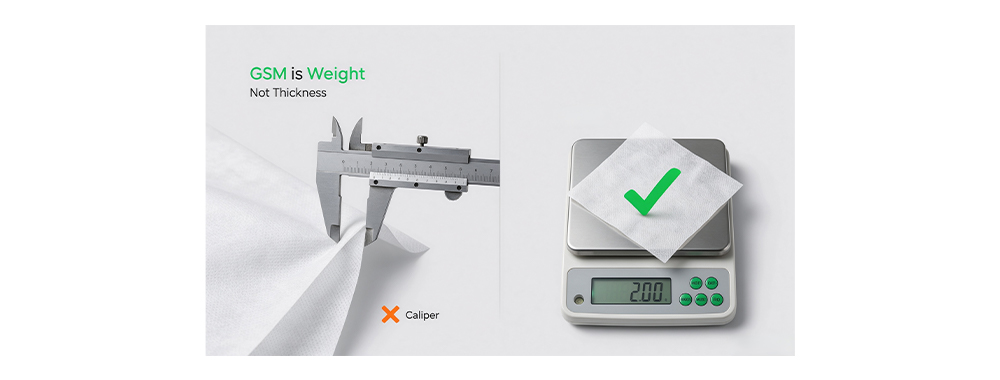
Myth 1: GSM Is the Same as Fabric Thickness
No. GSM measures weight per square meter, not physical thickness. Some low-quality fabrics inflate their thickness with loose, airy fibers while keeping the weight low—and their toughness is poor. Premium fabrics have dense, compact fibers, so at the same GSM they are more uniform in thickness and considerably tougher, outperforming those deceptively thick, low-quality materials.
Myth 2: Higher GSM Always Means a Better Bag
Not necessarily. The key to product selection is matching the bag to the use case, not chasing the highest weight. For short-term promotions and trade show giveaways, 70–80 GSM is usually more than enough. Choosing premium options above 110 GSM only adds procurement cost and wastes resources.
Myth 3: The Same GSM Means the Same Quality
Not necessarily. GSM is only a baseline parameter. Fabric quality also depends on raw material purity, manufacturing process, and fiber density. At the same weight, bags made from virgin materials are usually tougher, smoother, and more eco-friendly than those made from recycled scraps, with significant differences in service life and feel.
Myth 4: Load Capacity Depends Only on GSM
Load capacity is about more than just the fabric—handles and stitching matter just as much. No matter how high the GSM, if the handles are poorly welded or the stitching is sparse, the bag will still tear apart when loaded with heavy items.
Ⅴ. Scenario-Based Selection: Balancing Budget, Load, Size, and Reuse Needs
1. Budget-First
If your budget is limited, first clarify whether the bags are for a promotional campaign.
Promotional bags don’t need the heaviest fabric. As long as basic load and printing requirements are met, 70–80 GSM usually offers the best balance.
If your budget is extremely tight and the bags are only for one-off giveaways, 50–60 GSM can work—just keep in mind that these bags crease and tear easily and have a low reuse rate.
2. Load-First
If the bags need to carry heavier items such as books, beverages, gift boxes, or everyday goods, don’t rely on a higher GSM alone. A more reliable approach is:
• Start with at least 90 GSM
• Use stitched or reinforced ultrasonically welded handles
• Reinforce the bottom and side seams
• Run load tests before placing a bulk order
Heavier fabric is only the foundation—handles and stitching are where load capacity usually falls short.
3. Large-Size Bags
The larger the bag, the more stress it bears when loaded, and the higher the demands on fabric weight and construction. 70–80 GSM may be fine for small bags, but using a low GSM on large bags often leads to sagging bag bodies, torn handles, and broken bottoms. As a general guide:
• Small bags: 70–80 GSM
• Medium bags: 80–100 GSM
• Large bags or heavy-load bags: 100 GSM and above, with reinforced handles and bottoms
4. Long-Term Reuse
If you want customers to keep reusing your bags, don’t spec them like a one-off promotional tote. Prioritize:
• 80–100 GSM or higher
• Virgin material
• Stitched or reinforced welded handles
• Lamination or abrasion-resistant printing
• A structured shape that resists sagging
A reusable bag is essentially ongoing brand exposure, so quality and durability matter more than a rock-bottom price.
5. Export or Branded Custom Orders
For export orders and branded customization, confirm the following in addition to GSM:
• Whether the raw materials meet environmental requirements
• Whether REACH, RoHS, food-contact, or EU packaging (PPWR) compliance testing is required
• Whether the printing inks are eco-friendly
• Whether biodegradable or recyclable options are required
• Whether the stated fabric weight risks being overstated (weight inflation)
• Whether sampling and third-party inspection are supported
For these orders, don’t compare price alone. Evaluate fabric weight, raw materials, craftsmanship, certifications, and lead time together when comparing quotations.
Ⅵ. FAQ
Q1: Does a Higher GSM Always Mean a Better Non-Woven Bag?
Not necessarily. A higher GSM indicates greater quality potential but also higher cost, and the right choice always depends on the use case. Single-use scenarios don’t need extra-heavy fabric, while long-term reuse and brand-display scenarios can justify a higher GSM.
Q2: What Is the Standard GSM for Custom Non-Woven Bags?
The most common industry spec is 70–80 GSM, with around 80 GSM being the most balanced and popular choice. That said, it is not an absolute standard—the right weight depends on the bag style, size, application, and budget.
Q3: What GSM Is Considered a Heavyweight Non-Woven Bag?
Generally, 90 GSM and above can be described as heavyweight, while 110 GSM and above qualifies as a premium heavyweight option.
Q4: Why Do Two 80 GSM Bags Feel and Perform Differently?
Because raw materials, manufacturing processes, fiber density, and thickness uniformity all differ. An 80 GSM bag made from virgin material with a dense construction can outlast a 90 GSM bag made from recycled material with a loose construction.
Q5: Does GSM Matter for Biodegradable Non-Woven Bags?
Yes, it does—but biodegradable materials differ from standard PP non-woven fabric in density, hand feel, and strength, so you cannot directly compare GSM across different materials. You need to evaluate the actual material and test results. “Biodegradable non-woven bags” on the market mainly fall into two categories: oxo-degradable PP non-woven fabric made with degradation additives, and fully biodegradable non-woven fabric made from PLA + PBAT. These two types differ significantly in physical performance—even at the same GSM, their mechanical strength varies greatly, so they cannot be directly compared with standard PP non-woven bags.
Ⅶ. Summary
In short, GSM is an important yardstick for non-woven bag quality and a core parameter every buyer should master. It affects a bag’s feel, load capacity, durability, and price. There is no single “best” specification—only the option that best fits your needs.
Whether you are placing a small retail order or a large export order, choose the right GSM based on your use case, budget, size, handle construction, and printing requirements. This approach helps you avoid quality failures, keep costs under control, and create cost-effective custom non-woven bags.
As a non-woven bag manufacturer with decades of production experience, we are happy to help. If you are sourcing non-woven bags and are not sure which GSM is right for you, feel free to contact us—we will provide professional guidance on the best specification for your project.