- I. What Is the Difference Between Water Resistance and Waterproofing in Non-Woven Bags?
- II. What Kind of Fabric Is a Non-Woven Bag Actually Made Of?
- III. Actual Water-Resistance Performance of Untreated Non-Woven Bags
- IV. How to Improve the Water-Repellent and Moisture-Resistant Performance of Non-Woven Bags?
- V. Horizontal Comparison of the Waterproof Performance of Different Shopping Bag Fabrics
- VI. Purchasing Selection and Maintenance Recommendations (For B2B Procurement Customers)
- VII. FAQ — Frequently Asked Questions
- VIII. Conclusion
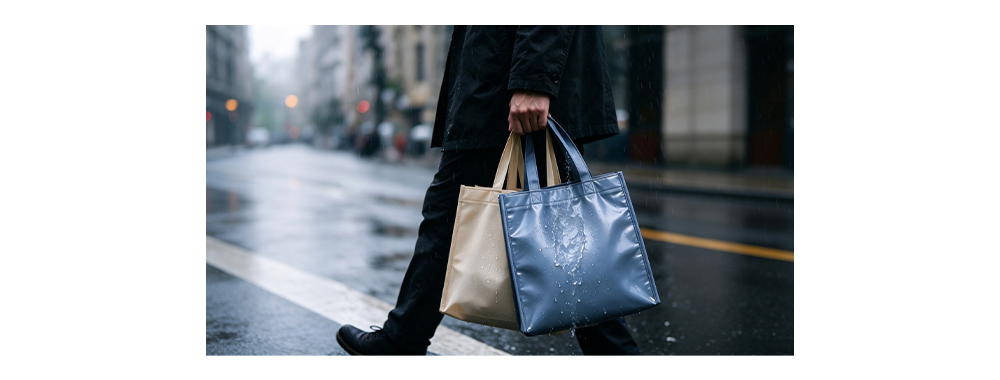
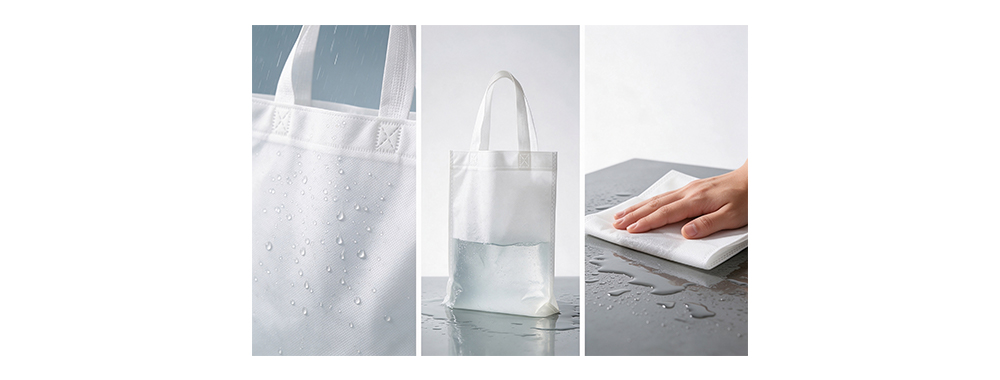
Untreated non-woven bags are water-resistant (splash-resistant), rather than completely waterproof. There are numerous micropores between the fibers of the fabric, which can resist slight moisture and occasional light rain; however, when exposed to continuous water, soaking, or pressure, water may still seep inside.
Laminated non-woven bags can achieve true waterproof performance. The lamination process involves bonding a dense plastic film (such as PP film or PE film) to the surface of the non-woven fabric. This film completely seals the micropores between the fibers and forms a continuous physical barrier, thereby effectively preventing the penetration of liquid water. However, if the bag is sewn, the needle holes can compromise the continuity of the film and become potential points of water penetration.
Therefore, although lamination significantly improves the overall waterproof performance, under high water pressure or prolonged soaking conditions, water may still slowly seep through the gaps around the stitching. If a higher level of waterproofing is required, a heat-sealed seamless process is usually needed, or additional sealing tape can be applied to the stitched areas.
I. What Is the Difference Between Water Resistance and Waterproofing in Non-Woven Bags?
This is the most important prerequisite for understanding fabric performance.
Water-repellent (splash-resistant): Water droplets briefly remain on the surface of the fabric and roll off. The fabric can only withstand short-term contact with water under low water pressure. Conventional PP non-woven bags fall into this category.
Waterproof: Under a specified water pressure, water is completely unable to penetrate the fabric. The industry generally uses the hydrostatic pressure (mmH₂O) indicator for quantitative evaluation; the higher the hydrostatic pressure value, the stronger the waterproofing capability.
The hydrostatic pressure of ordinary 80 GSM spunbond PP non-woven fabric is generally only 80–150 mmH₂O; the hydrostatic pressure of the fabric itself in laminated non-woven materials can reach 1000–2000 mmH₂O or higher, but sewing needle holes can directly compromise the overall hydrostatic pressure performance.
The vast majority of conventional non-woven bags only have splash-resistant properties; laminated non-woven bags with sealing tape treatment can achieve complete waterproofing in the strict sense (although the seams remain weak points for water penetration).
II. What Kind of Fabric Is a Non-Woven Bag Actually Made Of?
Although the name contains the word “fabric,” non-woven fabric is not woven fabric produced by interlacing traditional warp and weft yarns. The non-woven material commonly used for shopping bags is polypropylene (PP) fiber; loose fibers are consolidated and formed through heat bonding and mechanical bonding, without the need for spinning or weaving.
It is precisely this heat-bonding and consolidation method that determines its water permeability characteristics: the fibers are only pressed and bonded together rather than being tightly interwoven and locked together. Numerous tiny micropores naturally remain inside the fabric; air can pass through smoothly, while under water pressure or prolonged exposure to moisture, water molecules penetrate inward through these micropores. This characteristic exists in both spunbond non-woven fabric and air-laid non-woven fabric; the difference lies only in the density of the fiber arrangement, and the pores cannot be completely sealed.
Polypropylene fibers themselves are almost non-absorbent, but the fabric can be wetted by water. Water penetration mainly occurs through the capillary action generated by the gaps between the fibers.
III. Actual Water-Resistance Performance of Untreated Non-Woven Bags
Based on actual usage scenarios, the water-repellent performance of ordinary non-woven bags is as follows:
• Light drizzle and brief splashing: Water droplets roll down the surface of the bag, and the items inside can remain dry for a short period of time;
• Prolonged exposure to rain and direct immersion: After continuous wetting, water gradually penetrates inward through the micropores, causing the items inside the bag to become damp and wet;
• Pressure and high-humidity environments: When the bag is placed under heavy pressure on a damp surface, water penetration will be accelerated.
Fabric weight (GSM, grams per square meter) directly affects water resistance. The higher the fabric weight, the denser the fiber arrangement and the smaller the micropore size, resulting in improved water resistance. Most lightweight advertising and promotional non-woven bags on the market are made from 60–75 GSM fabric and have relatively weak moisture resistance; thicker non-woven fabric of 80 GSM or above provides significantly better splash resistance. However, even high-GSM ordinary non-woven fabric is still only water-resistant and cannot be defined as waterproof fabric. Simply increasing the fabric thickness cannot completely block the channels through which water penetrates.
IV. How to Improve the Water-Repellent and Moisture-Resistant Performance of Non-Woven Bags?
For applications in humid conditions, there are three mature processes commonly used in the industry to enhance water-repellent performance. These are also fabric selection solutions that we frequently provide to customers for our OEM & ODM customized orders:
1. Fabric Lamination (Most Widely Used)
A layer of PE or PP film is thermally laminated onto the surface of the non-woven fabric substrate (the film thickness is typically 0.01–0.03 mm). The continuous plastic film forms a physical water-blocking barrier, which can greatly prevent the penetration of liquid water.
Laminated non-woven bags offer excellent water-repellent performance, and the bag surface is easy to wipe and clean; the disadvantage is that the breathability of the fabric will decrease significantly.
Important Reminder: If the bag still uses conventional sewing techniques, the sewing needle holes and seams still pose a risk of water penetration; to achieve truly complete water-tight sealing, a heat-sealed, needle-free sewing process must be used (there are two types: ultrasonic heat sealing and hot-press heat sealing).
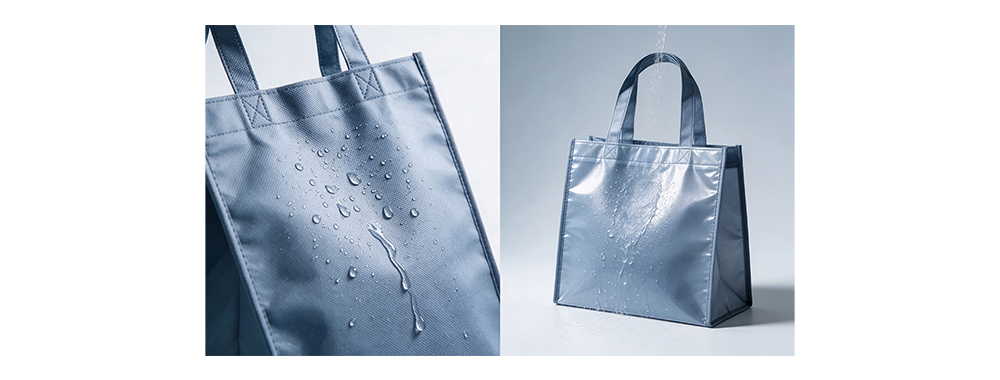
2. Water-Repellent Functional Coating
A water-repellent coating is applied to the surface of non-woven fibers through padding or spraying processes. At present, fluorine-free, environmentally friendly water-repellent coatings are a relatively popular eco-friendly upgrade solution. The coating creates a microscopic rough structure on the fiber surface, causing water droplets to form beads and roll off the surface of the bag, while improving water-repellent performance and retaining the original breathability of the non-woven fabric as much as possible. This is suitable for orders that require a certain degree of moisture resistance while still needing to maintain breathability.
Additional Note: Compared with traditional fluorine-containing water-repellent systems, fluorine-free environmentally friendly water-repellent coatings have relatively weaker resistance to rubbing and washing. After repeated friction and multiple washes, the water-repellent effect will gradually diminish. They are more suitable for light moisture-resistance applications and are not suitable for conditions involving long-term and repeated contact with water.
3. Hydrophobic Treatment of the Fiber Itself
Polypropylene material itself is almost non-absorbent; the main pathways for water penetration are the gaps between the fibers. By adding hydrophobic additives at the raw material stage, the capillary penetration rate of water through the gaps between the fibers can be reduced. This process is generally not used as an independent solution and is mostly combined with a surface coating to further optimize moisture resistance.
V. Horizontal Comparison of the Waterproof Performance of Different Shopping Bag Fabrics
| Material | Waterproof Performance | Breathability | Suitable Applications |
| Ordinary PP Non-Woven Fabric | Medium (water-resistant and splash-resistant only) | High | Storing dry goods, short-term use in light rain, daily supermarket shopping |
| Laminated Non-Woven Fabric | High (waterproof; risk of leakage at sewn areas) | Relatively low | Outdoor use on rainy days, temporary storage of damp items, premium retail packaging |
| Thin Disposable Plastic Bags | High (completely waterproof) | None | Disposable temporary carrying; significant environmental drawbacks |
| Untreated Canvas | Low, very easy to absorb water | Medium | Suitable only for dry environments; not suitable for wet goods |
| Waterproof-Coated Canvas | High | Relatively low | Heavy-duty outdoor bags |
Disposable plastic bags have good sealing performance, but their single-use nature creates a significant environmental burden; traditional canvas is durable and abrasion-resistant and can be washed repeatedly, but it absorbs water very easily when exposed to moisture. Non-woven bags happen to fall between these two: compared with canvas, they offer better water resistance; compared with plastic bags, they retain breathability and are more suitable for repeated and circular use. This is also why many brand customers choose non-woven bags as environmentally friendly gift bags.
VI. Purchasing Selection and Maintenance Recommendations (For B2B Procurement Customers)
Customization and Selection Recommendations
woven bags can handle occasional light rain and are suitable for purchasing fresh food ingredients (their breathability helps prevent fruits and vegetables from becoming stuffy and deteriorating); however, ordinary non-woven bags do not provide sufficient protection in heavy rain. It is recommended to use a waterproof inner bag or choose a laminated version directly.
1. If the project application frequently involves exposure to rainwater or requires temporary storage of damp goods: give priority to laminated or water-repellent coated non-woven fabric; at the same time, note that if strict water-blocking performance is required, a heat-sealed, needle-free process should be evaluated, along with the corresponding MOQ and quotation;
2. Give priority to fabric weight: 80–100 GSM fabric offers a better overall balance of hand feel and basic moisture resistance compared with lightweight 60–70 GSM advertising bags;
3. For daily promotions and supermarket shopping bags used in dry environments: ordinary non-woven fabric can be selected directly, which helps control overall purchasing costs.
Product Care and Usage Recommendations
Ordinary non-woven bags can handle occasional light rain and are suitable for purchasing fresh food ingredients (their breathability helps prevent fruits and vegetables from becoming stuffy and deteriorating); however, ordinary non-woven bags do not provide sufficient protection in heavy rain. It is recommended to use a waterproof inner bag or choose a laminated version directly.
• For cleaning, prioritize localized wiping with a damp cloth, or gently hand-wash with cold water;
• Machine washing, spin-drying, and high-temperature drying are strictly prohibited, as vigorous rubbing and high temperatures can damage the thermal bonding between the fibers, causing the fabric to become loose and damaged;
• Do not use bleach for cleaning; after washing, place the bag in a ventilated area and allow it to air-dry naturally.
VII. FAQ — Frequently Asked Questions
Q1: Can non-woven bags be used to carry wet clothes?
They are acceptable for short-distance, temporary carrying. After ordinary non-woven bags hold wet clothes for a long period of time, water may seep outward through the micropores, easily wetting surrounding items. If wet clothes need to be stored frequently, it is recommended to use a laminated non-woven bag.
Q2: Can laminated non-woven bags come into direct contact with food?
This cannot be generalized. Whether they can come into contact with food depends on whether the laminated film has the required food-contact compliance certification. For conventional promotional and gift-type laminated non-woven bags, direct contact with cooked food or ready-to-eat food is not recommended; if they are to be used for baking or food packaging projects, food-contact material compliance requirements need to be clearly specified during the customization stage.
Q3: Can ordinary non-woven bags be used on rainy days?
They can be used outdoors for short periods in conditions involving occasional light rain; however, their reliability is insufficient during prolonged exposure to heavy rain. A laminated version should be prioritized, or an additional waterproof inner lining should be added.
Q4: Can non-woven bags be machine-washed and tumble-dried?
It is not recommended. The agitation during machine washing and high-speed spin-drying can damage the thermal-bonding structure of the fibers; high-temperature drying can also cause fabric shrinkage and localized delamination. Prioritize wiping with a damp cloth, or gently hand-wash with cold water and then air-dry in a ventilated, shaded area; do not use bleach.
Q5: Are non-woven bags considered eco friendly bags?
Whether they are environmentally friendly depends on the actual frequency of reuse.
The polypropylene substrate of non-woven bags is not biodegradable in the natural environment, but it supports thermal recovery and recycling; although biodegradable non-woven fabrics are available on the market, they are rarely used for conventional shopping bags. Their environmental advantage comes from repeated and circular reuse. Only when a sufficient number of reuse cycles is achieved can the overall environmental burden of non-woven bags be lower than that of disposable plastic bags; if they are used only once and then discarded, they are actually not environmentally friendly.
Q6: How Can You Quickly Tell Whether a Non-Woven Bag Is Laminated?
Simple identification tips:
① Check the surface appearance: Glossy laminated bags have a stronger shine; matte laminated bags do not have a high-gloss surface, but the color saturation of the printing remains higher;
② Light transmission test: Laminated fabric has significantly lower light transmission;
③ Feel and rub the fabric: Laminated bags feel relatively firm and smooth. When rubbing the bag, you can hear the friction sound of the plastic film (this characteristic applies to both glossy and matte films).
VIII. Conclusion
The inherent property of non-woven bags is water resistance and splash resistance, rather than complete waterproofing. Ordinary non-woven bags are sufficient for most daily purchasing scenarios and can handle occasional moisture and short periods of light rain; when an order requires stronger moisture and rain resistance, lamination or a functional water-repellent coating is an effective solution, while retaining the advantages of non-woven bags being lightweight and suitable for repeated use.
When carrying out OEM & ODM customized procurement of waterproof non-woven bags, it is necessary to consider the actual end-use environment, confirm the fabric GSM, and determine whether lamination or a water-repellent coating should be added; if an extremely high level of rain protection is required, the heat-sealed, needle-free process should also be further evaluated to avoid the risk of water penetration through sewing needle holes.
As a non-woven bag OEM & ODM manufacturer with 16 years of production experience, we can assist customers in selecting suitable fabrics based on the actual application scenarios of their projects, work together to finalize the GSM and surface finishing processes, and identify potential risks and control bulk production quality during the early stages of the project. We welcome you to discuss your non-woven bag customization project with us.